CTAL-TA_V4.0 Download, New CTAL-TA_V4.0 Exam Answers
Wiki Article
It is very convenient for all people to use the CTAL-TA_V4.0 study materials from our company. Our study materials will help a lot of people to solve many problems if they buy our products. The online version of CTAL-TA_V4.0 study materials from our company is not limited to any equipment, which means you can apply our study materials to all electronic equipment, including the telephone, computer and so on. So the online version of the CTAL-TA_V4.0 Study Materials from our company will be very useful for you to prepare for your exam. We believe that our study materials will be a good choice for you.
In order to ensure the quality of our CTAL-TA_V4.0 actual exam, we have made a lot of efforts. Our company spent a great deal of money on hiring hundreds of experts and they formed a team to write the work. The qualifications of these experts are very high. They have rich knowledge and rich experience on the CTAL-TA_V4.0 Study Guide. So they know every detail about the CTAL-TA_V4.0 exam questions and can make it better. With our CTAL-TA_V4.0 learning guide, you will be bound to copyright.
New CTAL-TA_V4.0 Exam Answers & Certification CTAL-TA_V4.0 Training
ExamDumpsVCE release the best high-quality ISQI CTAL-TA_V4.0 exam original questions to help you most candidates pass exams and achieve their goal surely. our ISQI CTAL-TA_V4.0 Materials can help you pass exam one-shot. ExamDumpsVCE sells high passing-rate preparation products before the real test for candidates.
ISQI ISTQB Certified Tester Advanced Level Test Analyst (CTAL-TA v4.0) Sample Questions (Q43-Q48):
NEW QUESTION # 43
A simple DVD player is described in the following state transition diagram:
States shown in the diagram: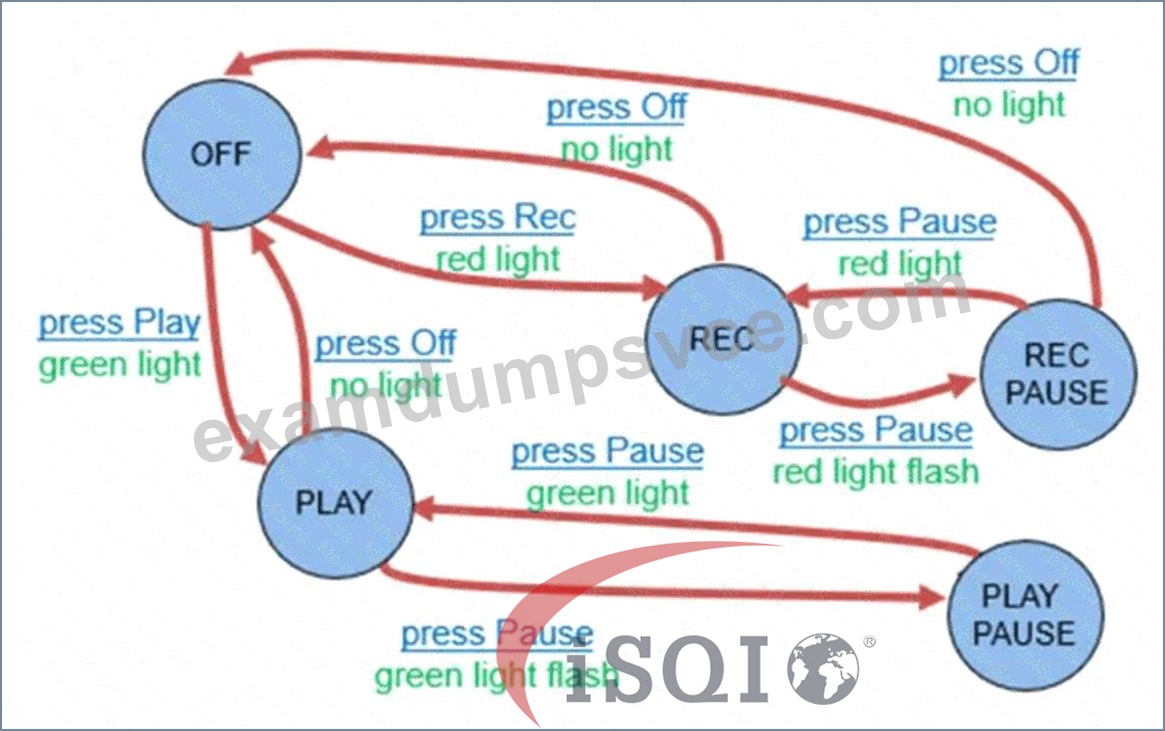
All round trips are feasible, even those that do not start at OFF. How many test cases will be needed for complete round-trip coverage?
- A. 0
- B. 1
- C. 2
- D. 3
Answer: B
Explanation:
The correct answer is B , because complete round-trip coverage requires every feasible round trip in the state model to be covered, not only those that start from the initial OFF state. CTAL-TA v4.0 explicitly includes state transition testing with N-switch and round-trip coverage as the focus of its state transition topic. A round trip is a path that starts and ends in the same state, normally without repeating an intermediate state.
The feasible round trips are:
* OFF # PLAY # OFF
* PLAY # OFF # PLAY
* OFF # REC # OFF
* REC # OFF # REC
* REC # REC PAUSE # REC
* REC PAUSE # REC # REC PAUSE
* PLAY # PLAY PAUSE # PLAY
* PLAY PAUSE # PLAY # PLAY PAUSE
* OFF # REC # REC PAUSE # OFF
* REC # REC PAUSE # OFF # REC
* REC PAUSE # OFF # REC # REC PAUSE
That gives 11 round trips. The warning in the question is important: if only OFF-starting round trips were counted, the answer would be too low. Option A overcounts by adding a non-modeled or duplicate round trip.
Options C and D miss feasible non-OFF-starting round trips. Reference: CTAL-TA v4.0, Section 3.2.2 State Transition Testing , round-trip coverage.
NEW QUESTION # 44
Your project is developing an application to process claims against insurance policies. Which of the following is a good example of CRUD completeness testing?
- A. A review of the technical specifications to check that the abilities to create, read, update and delete a claim have been included in the application architecture
- B. A set of test cases that verify the sequence of creating, reading, updating, reading and deleting a claim, and then check that it can no longer be read
- C. A set of test cases that, when executed, verify the application's ability to independently create, read, update and delete a claim
- D. A review of the requirements to check that all user needs for CRUD operations on a claim record have been elicited
Answer: A
Explanation:
The correct answer is C because CRUD completeness testing is a static activity. CTAL-TA v4.0 defines CRUD as create, read, update, and delete, and states that CRUD testing verifies the lifecycle of data entities processed by the test item. The syllabus distinguishes two parts: CRUD completeness testing , which statically verifies whether all possible CRUD operations occur for every entity, and CRUD consistency testing , which dynamically checks whether functions interact correctly when handling the entity.
For an insurance-claims application, the key entity is the claim . A technical review checking whether the architecture/specification includes the ability to create, read, update, and delete claim records directly matches CRUD completeness. It is concerned with whether the full claim lifecycle has been included, not whether the lifecycle behaves correctly during execution. Option A is a strong example of CRUD consistency testing because it executes a lifecycle sequence and checks post-delete behavior. Option B is also dynamic execution, so it is not the best match for completeness. Option D is requirements elicitation completeness, not specifically CRUD completeness for the implemented claim entity. Reference: CTAL-TA v4.0, Section 3.2.1 CRUD Testing .
NEW QUESTION # 45
You are working on a project to replace an old sales and merchandising system with a new system that will be based on modern platforms. The old system is still in production but is poorly documented and expensive to maintain. The new version will be developed using modern technology. The main requirements for the system are that it shall:
* Load sales data, sent electronically from the stores each evening, into a central database.
* Produce actual sales reports for the merchandisers, whose job is to manage stock levels in stores.
* Produce sales forecast reports, based on a combination of sales history and forecasting parameters. The parameters will be entered by the merchandisers into a browser-based front end and the reports will be produced overnight. The users will be able to see the reports next day, on screen or in print, by requesting this through the browser.
Requirements 1 and 2 are satisfied by the existing system and will be rewritten with no significant functional changes. Requirement 3 is new and has been clearly specified. Because of the poor test basis you have decided to perform experience-based functional correctness testing for requirements 1 and 2 with the support of checklists. Which would be the BEST items to include in the checklist for testing Requirement 2?
a) Does the sales quantity in the database for any one product in a particular store, equal the sales data input for that product / store?
b) Does the total sales value in the report for all products in a particular store, equal the sales data input for that store?
c) Does the sales quantity in the report for any one product in a particular store, equal the sales data input for that product / store?
d) Does successful login allow access to the report parameter entry features?
e) Does the total sales value in the database for all products in a particular store, equal the sales data input for that store?
- A. d) and e)
- B. b) and c)
- C. b) and d)
- D. a) and c)
Answer: B
Explanation:
The correct answer is C because Requirement 2 is specifically about producing actual sales reports for merchandisers. CTAL-TA v4.0 states that checklist-based testing helps the Test Analyst cover known essential aspects of a test item, prevents overlooking critical areas, and supports experience-based testing when documentation is weak or changing. It also states that checklist items should be clear, specific, relevant, actionable, measurable, and answerable with yes, no, or not applicable.
Checklist item b is relevant because it verifies that the report total sales value for a store matches the sales input for that store. Checklist item c is also relevant because it verifies that the report shows the correct sales quantity for a specific product/store combination. These two checks directly test the functional correctness of the actual sales reports .
Item a is not the best fit because it checks data in the database , which belongs more directly to Requirement
1, loading sales data into the central database. Item d belongs to Requirement 3, because report parameter entry is part of the new sales forecast reporting feature. Item e again checks database content rather than report output. Reference: CTAL-TA v4.0, Section 3.4.2 Checklists Supporting Experience-Based Test Techniques and Section 4.1 Functional Testing .
NEW QUESTION # 46
You are working on a project to build a purchasing system. The main requirements for the system are that it shall:
* Allow users to enter details of items that they wish to have purchased and, from these details, create a purchase request.
* Take each purchase request through a workflow that will allow the requestor's line manager to approve the request, reject it or return it for clarification / modification.
* Forward approved requests to the Purchasing Department.
* Allow purchasers to find the best available supplier for each approved request and place the request on that supplier as a purchase order.
The solution is being developed according to the company's traditional V-model methodology. The requirements are clearly documented and include a business process model.
System testing has finished and the test manager has asked you, the senior TA, to identify any parts of the product that should be focused on during acceptance testing. The results of this may be used to adjust the acceptance test plan.
You are using defect cluster analysis, only counting defects with severity levels 1 to 3, ignoring low severity levels 4 and 5. Function point analysis was used for estimating, so you have used function points as the unit of size for the various functional areas of the product. No numeric estimates of expected defect quantities were made for them individually but, as a result of product risk analysis, these functional areas have been ranked according to the amount of product risk that was predicted in them, with risk ranking 1 being the highest and
5 the lowest; the thoroughness of the testing performed so far has been proportional to that. The results are presented in the table below.
Functional area
Total function points
Product risk ranking
Defects found
Purchase Request entry
2000
2
30
Purchase Request workflow
1500
4
15
Purchase Request authorisation
1000
5
25
Supplier identification
2000
1
30
Purchase Order creation
1000
3
30
Which functional areas would you recommend for more test focus in acceptance testing?
a) Purchase Request entry
b) Purchase Request workflow
c) Purchase Request authorization
d) Supplier Identification
e) Purchase Order creation
- A. a) and d)
- B. c) and e)
- C. a) and b)
Answer: B
Explanation:
The correct answer is C because defect cluster analysis must not be based on raw defect counts alone. CTAL- TA v4.0 states that after testing, the Test Analyst can identify actual defect-prone areas and compare predicted versus actual defect clusters; where discrepancies appear, more rigorous testing may be needed in those areas.
Here, size must be normalized using function points. The defect densities are: Purchase Request entry 30
/2000 = 15 defects per 1000 FP , Purchase Request workflow 15/1500 = 10 defects per 1000 FP , Purchase Request authorization 25/1000 = 25 defects per 1000 FP , Supplier identification 30/2000 = 15 defects per
1000 FP , and Purchase Order creation 30/1000 = 30 defects per 1000 FP .
The strongest actual clusters are therefore Purchase Order creation and Purchase Request authorization .
This is even more significant because authorization had the lowest predicted product risk ranking, 5 , so it should not have produced such a high defect density if the original risk assessment and test focus were accurate. Purchase Order creation also shows the highest defect density despite only medium predicted risk, ranking 3. Supplier identification and Purchase Request entry both have 30 defects, but they are larger areas and have only 15 defects per 1000 function points; Supplier identification was also the highest predicted risk area, so more defects there are less surprising. Reference: CTAL-TA v4.0, Software Defect Prevention , test result analysis and predicted-versus-actual defect cluster analysis.
NEW QUESTION # 47
The following activity diagram, drawn in Business Process Modeling Notation (BPMN), shows the process of raising a Purchase Request (PR), getting it authorized and raising a Purchase Order from it.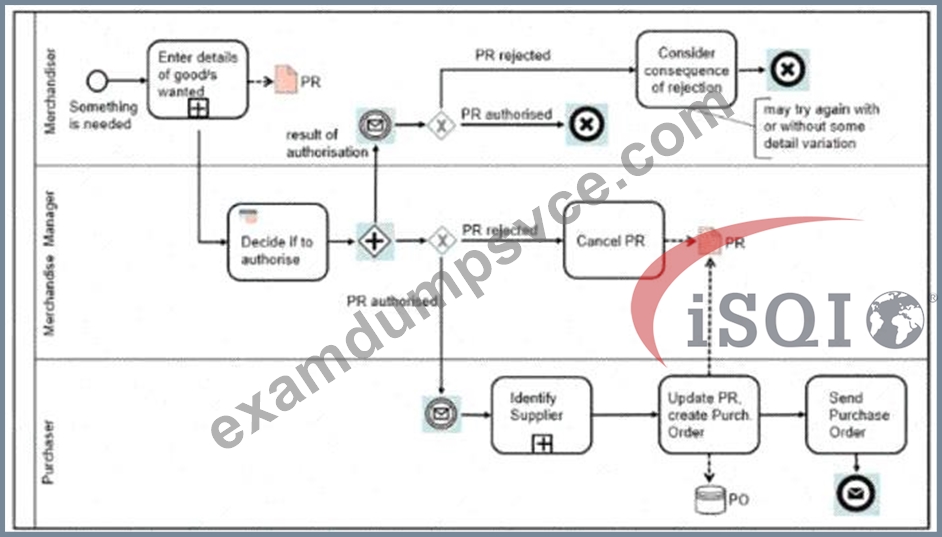
What is the minimum quantity of test cases that will be needed to cover all scenarios?
- A. 0
- B. 1
- C. 2
- D. 3
Answer: A
Explanation:
The correct answer is B , because the BPMN model contains two executable end-to-end scenarios . CTAL- TA v4.0 classifies scenario-based testing as a behavior-based technique where the Test Analyst creates a scenario model from action sequences that form workflows through the test item. The syllabus specifically mentions activity diagrams and BPMN-style workflow models as scenario-model sources, and states that test cases are designed to cover the identified scenarios.
In the diagram, the process starts when something is needed and the merchandiser enters the details of goods wanted. The manager then decides whether to authorize the PR. From that decision, there are only two real scenario outcomes. The first is the authorized scenario : the PR is authorized, the supplier is identified, the PR is updated and a Purchase Order is created, and the Purchase Order is sent. The second is the rejected scenario : the PR is rejected, the PR is cancelled, and the merchandiser considers the consequence of rejection.
The notification/result-of-authorization flow does not create separate scenarios; it is part of the same authorized or rejected process path. The note saying the merchandiser may try again is not a modeled loop because no BPMN flow returns to the start. CTAL-TA states that when the scenario model has no loops, each scenario can be tested with a separate test case. Therefore, the minimum quantity is 2 test cases .
NEW QUESTION # 48
......
We believe in most cases our CTAL-TA_V4.0 exam study materials are truly your best friend. On one hand, our CTAL-TA_V4.0 learning guide is the combination of the latest knowledge and the newest technology, which could constantly inspire your interest of study. On the other hand, our CTAL-TA_V4.0 test answers can predicate the exam correctly. Through highly effective learning method and easily understanding explanation, you will pass the CTAL-TA_V4.0 Exam with no difficulty. Our slogans are genuinely engraving on our mind that is to help you pass the CTAL-TA_V4.0 exam, and ride on the crest of success!
New CTAL-TA_V4.0 Exam Answers: https://www.examdumpsvce.com/CTAL-TA_V4.0-valid-exam-dumps.html
If you attach great importance to the protection of personal information and want to choose a very high security product, CTAL-TA_V4.0 real exam is definitely your first choice, There is nothing superfluous or irrelevant in ExamDumpsVCE’s CTAL-TA_V4.0 dumps that wastes your time and energy, Our ISTQB Certified Tester Advanced Level Test Analyst (CTAL-TA v4.0) (CTAL-TA_V4.0) questions product is getting updated regularly as per the original ISTQB Certified Tester Advanced Level Test Analyst (CTAL-TA v4.0) (CTAL-TA_V4.0) practice test’s content, Moreover, CTAL-TA_V4.0 training materials cover most of knowledge points for the exam, and you can master the major knowledge points as well as improve your professional ability after practicing.
It really does look like paper, We are all used CTAL-TA_V4.0 New copyright Book to the three physical dimensions of height, width, and depth, If you attach great importance to the protection of personal information and want to choose a very high security product, CTAL-TA_V4.0 Real Exam is definitely your first choice.
Latest Upload CTAL-TA_V4.0 Download - ISQI New ISTQB Certified Tester Advanced Level Test Analyst (CTAL-TA v4.0) Exam Answers
There is nothing superfluous or irrelevant in ExamDumpsVCE’s CTAL-TA_V4.0 dumps that wastes your time and energy, Our ISTQB Certified Tester Advanced Level Test Analyst (CTAL-TA v4.0) (CTAL-TA_V4.0) questions product is getting updated regularly as per the original ISTQB Certified Tester Advanced Level Test Analyst (CTAL-TA v4.0) (CTAL-TA_V4.0) practice test’s content.
Moreover, CTAL-TA_V4.0 training materials cover most of knowledge points for the exam, and you can master the major knowledge points as well as improve your professional ability after practicing.
To be recognized as the leading international Certification CTAL-TA_V4.0 Training exam bank in the world through our excellent performance, our ISTQB Certified Tester Advanced Level Test Analyst (CTAL-TA v4.0) qualification test are being concentrated on for a long CTAL-TA_V4.0 time and have accumulated mass resources and experience in designing study materials.
- Free Download CTAL-TA_V4.0 Download - Leader in Qualification Exams - Efficient CTAL-TA_V4.0: ISTQB Certified Tester Advanced Level Test Analyst (CTAL-TA v4.0) ???? Enter ➥ www.examcollectionpass.com ???? and search for 「 CTAL-TA_V4.0 」 to download for free ????CTAL-TA_V4.0 Latest Exam Questions
- CTAL-TA_V4.0 Valid Study Material - CTAL-TA_V4.0 Test Training Pdf - CTAL-TA_V4.0 Latest Pep Demo ???? Open ➠ www.pdfvce.com ???? enter ( CTAL-TA_V4.0 ) and obtain a free download ????CTAL-TA_V4.0 Exam Dumps Provider
- Most CTAL-TA_V4.0 Reliable Questions ???? CTAL-TA_V4.0 Test Dumps Pdf ???? Valid copyright CTAL-TA_V4.0 Ebook ???? Immediately open ▷ www.vce4dumps.com ◁ and search for ⮆ CTAL-TA_V4.0 ⮄ to obtain a free download ☝CTAL-TA_V4.0 Study Plan
- Valid copyright CTAL-TA_V4.0 Ebook ???? CTAL-TA_V4.0 Test Labs ???? Verified CTAL-TA_V4.0 Answers ???? The page for free download of ▷ CTAL-TA_V4.0 ◁ on ⇛ www.pdfvce.com ⇚ will open immediately ????Most CTAL-TA_V4.0 Reliable Questions
- Pass Guaranteed ISQI - CTAL-TA_V4.0 - Updated ISTQB Certified Tester Advanced Level Test Analyst (CTAL-TA v4.0) Download ???? Open 《 www.practicevce.com 》 enter 《 CTAL-TA_V4.0 》 and obtain a free download ☑New CTAL-TA_V4.0 Test Vce
- CTAL-TA_V4.0 Passing Score ???? Composite Test CTAL-TA_V4.0 Price ???? CTAL-TA_V4.0 Test Labs ???? Easily obtain free download of ⇛ CTAL-TA_V4.0 ⇚ by searching on 【 www.pdfvce.com 】 ⛴Valid CTAL-TA_V4.0 Test Guide
- Valid CTAL-TA_V4.0 Test Guide ???? CTAL-TA_V4.0 New Guide Files ???? CTAL-TA_V4.0 Test Dumps Pdf ???? Download ( CTAL-TA_V4.0 ) for free by simply entering ⮆ www.prepawaypdf.com ⮄ website ????New CTAL-TA_V4.0 Test Vce
- ISQI CTAL-TA_V4.0 Practice Test Material in 3 Different Formats ???? Go to website ➠ www.pdfvce.com ???? open and search for ⏩ CTAL-TA_V4.0 ⏪ to download for free ????CTAL-TA_V4.0 Test Dumps Pdf
- Free Download CTAL-TA_V4.0 Download - Leader in Qualification Exams - Efficient CTAL-TA_V4.0: ISTQB Certified Tester Advanced Level Test Analyst (CTAL-TA v4.0) ???? Open ▶ www.practicevce.com ◀ enter ➤ CTAL-TA_V4.0 ⮘ and obtain a free download ????CTAL-TA_V4.0 Passing Score
- CTAL-TA_V4.0 Test Labs ???? Most CTAL-TA_V4.0 Reliable Questions ❕ New CTAL-TA_V4.0 Test Vce ???? The page for free download of ✔ CTAL-TA_V4.0 ️✔️ on ➡ www.pdfvce.com ️⬅️ will open immediately ????Reliable CTAL-TA_V4.0 copyright Sheet
- ISQI CTAL-TA_V4.0 Practice Test Material in 3 Different Formats ???? Enter ▷ www.prepawaypdf.com ◁ and search for ➤ CTAL-TA_V4.0 ⮘ to download for free ????CTAL-TA_V4.0 Test Dumps Pdf
- nicoledgsu492807.digitollblog.com, kaitlynodnr629120.blogthisbiz.com, scrapbookmarket.com, www.stes.tyc.edu.tw, dillanyamx864405.homewikia.com, macieaqzw472976.blog4youth.com, sairabidz184852.jasperwiki.com, www.stes.tyc.edu.tw, jimiglv078830.wikilentillas.com, poppykjzz599211.snack-blog.com, Disposable vapes